You are here

The Certificate in Jewish Leadership

The Certificate in Jewish Leadership

Students Michael Waitz and Shalom Klein

The Certificate in Jewish Leadership—sponsored by Northwestern University School of Continuing Studies and Spertus Institute for Jewish Learning and Leadership—is dedicated to transforming American Jewish life by enhancing the professional abilities of Jewish leaders. The curriculum is rooted in the belief that Judaism has its own distinct and insightful approaches to leadership. Through lectures, group work, and individual mentoring led by Northwestern and Spertus faculty, participants learn best practices drawn from contemporary leadership principles and classical Jewish texts and thought.

Next Cohort Begins Fall 2013
For more information,
contact Dr. Dean Bell at
dbell@spertus.edu or
312.322.1791.

Traditionally, programs for Jewish leadership have focused either on management skills or Jewish literacy. In this program, leadership training is taught within a distinctively Jewish context. Participants learn to access and improve their own leadership, to articulate vision and inspire and motivate stakeholders, to improve collaboration, to achieve organizational goals, to hone their communication skills, and to plan and execute for the future.

Curriculum
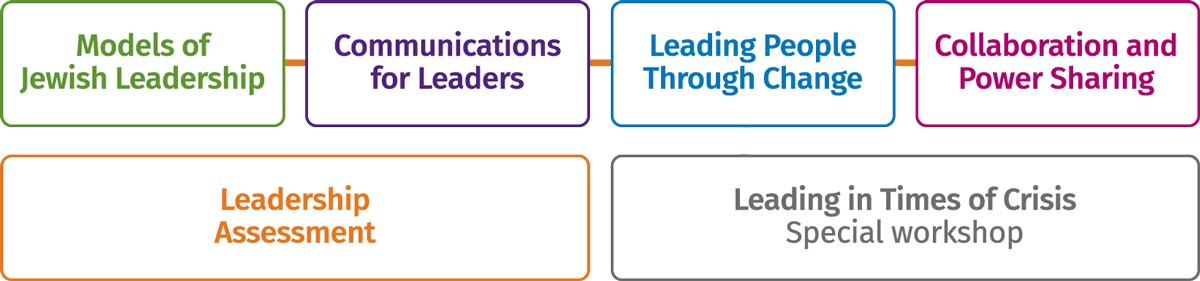
The curriculum is a four-module sequence offered on Northwestern's Evanston campus and at Spertus in Downtown Chicago. It begins with an intensive two-day seminar and continues with three modules, the first two meeting on Monday evenings and the last on a program concluding Sunday and Monday. The program includes mentoring with senior Jewish community leaders in Chicago. Participants proceed through the curriculum as a cohort, which provides opportunities for peer learning and networking.

Modules and Schedule
To earn the certificate, students must complete all four modules.

The following dates are those of the previous cohort, provided
here as an example of how the schedule works.

Session Dates

 Session Times

 Theme

 May 5-6  

9-5 pm 

 Models of
 Jewish  
 Leadership

May 13, 20
and 27

6-9 pm

 Communications 
 for Leaders

June 3, 10
and 17  
 
 6-9 pm

 Collaboration

June 23 and 24

 9-5 pm

Leading People  
Through Change and Program Conclusion


About Northwestern University

  • Northwestern University is a preeminent university recognized internationally as a hallmark of academic excellence.
  • Northwestern's School of Continuing Studies (SCS) provides students with exceptional opportunities for intellectual, professional, and personal growth.
  • SCS instructors bring outstanding academic credentials and relevant professional experience to the classroom to create a highly interactive, collaborative, and challenging learning environment.
  • SCS students study with peers who have rich, diverse backgrounds and can provide lifelong learning connections.

About Spertus Institute

  • Spertus has a long and rich history of innovative programming that serves the needs of Jewish educators and communal professionals.
  • Spertus’ outstanding, diverse, and non-denominational offerings are multifaceted, grounded in Jewish thought, inspired by Jewish values, and resolutely relevant to contemporary life.
  • Spertus graduate-level degree programs, professional certificates, and workshops in areas of Jewish Studies, Jewish Professional Studies, and Nonprofit Management blend theory and practice and are taught by leading faculty with real-world experience.
  • Spertus serves diverse students around the globe through on-campus and distance-learning programs.

Registration Information

The Certificate in Jewish Leadership is a selective admissions program. Applicants should have 3-5 years of professional experience and a strong commitment to full participation in the program. APPLY>

Intended Audience

The curriculum has been developed for emerging leaders of nonprofit organizations, including those focused on social service, fundraising, education, culture, and public policy advocacy. Experienced leaders of Jewish organizations and professionals working outside the Jewish community will also find the program offers benefits to their work through its focus on best practices in a Jewish context.

Professional Mentoring

A unique and essential aspect of the program is its focus on the mentoring of students by seasoned Jewish professional and lay leaders. 

Mentors to date have included:

Aleen Bayard, Founder, MarketZing and Adjunct Faculty, Northwestern University

Aaron Cohen, Associate Vice President of Leadership and Campaign, Jewish Federation of Metropolitan Chicago

Daniel Elbaum, Director, American Jewish Committee, Chicago Regional Office

Greg Gross, President & CEO, Michael Reese Health Trust

Dr. Michael Kotzin, Executive Vice President, Jewish Federation of Metropolitan Chicago

Dr. Elliot Lefkovitz, Former Director of Education, Congregation Am Shalom and Faculty, Spertus Institute

Dr. Hal M. Lewis, President and CEO, Spertus Institute

Dr. David Rubovits, Senior Vice President of Planning and Allocations, Jewish Federation of Metropolitan Chicago

Emily Soloff, Associate Director of Interreligious and Intergroup Relations, American Jewish Committee

Jill Weinberg, Midwest Regional Director, U.S. Holocaust Memorial Museum

Mark Weiner, President and CEO, Council for Jewish Elderly (Chicago)

Richard Zelin, Vice President of Development, Sinai Health System

Learning Outcomes

Participants who complete the certificate program will be able to:

  • Analyze, explain, and model what it means to be an effective leader by drawing upon Jewish scholarship and classical texts and best practices
  • Apply ethical principles based on Jewish traditions into daily leadership practices
  • Demonstrate an understanding of key qualities of effective leadership based on contemporary leadership theory
  • Develop a repertoire of supervisory, conflict resolution, and change management skills
  • Implement strategies and techniques for effective collaboration, team building, and communication
  • Synthesize what is learned in this program to solve problems within the participant’s organization