
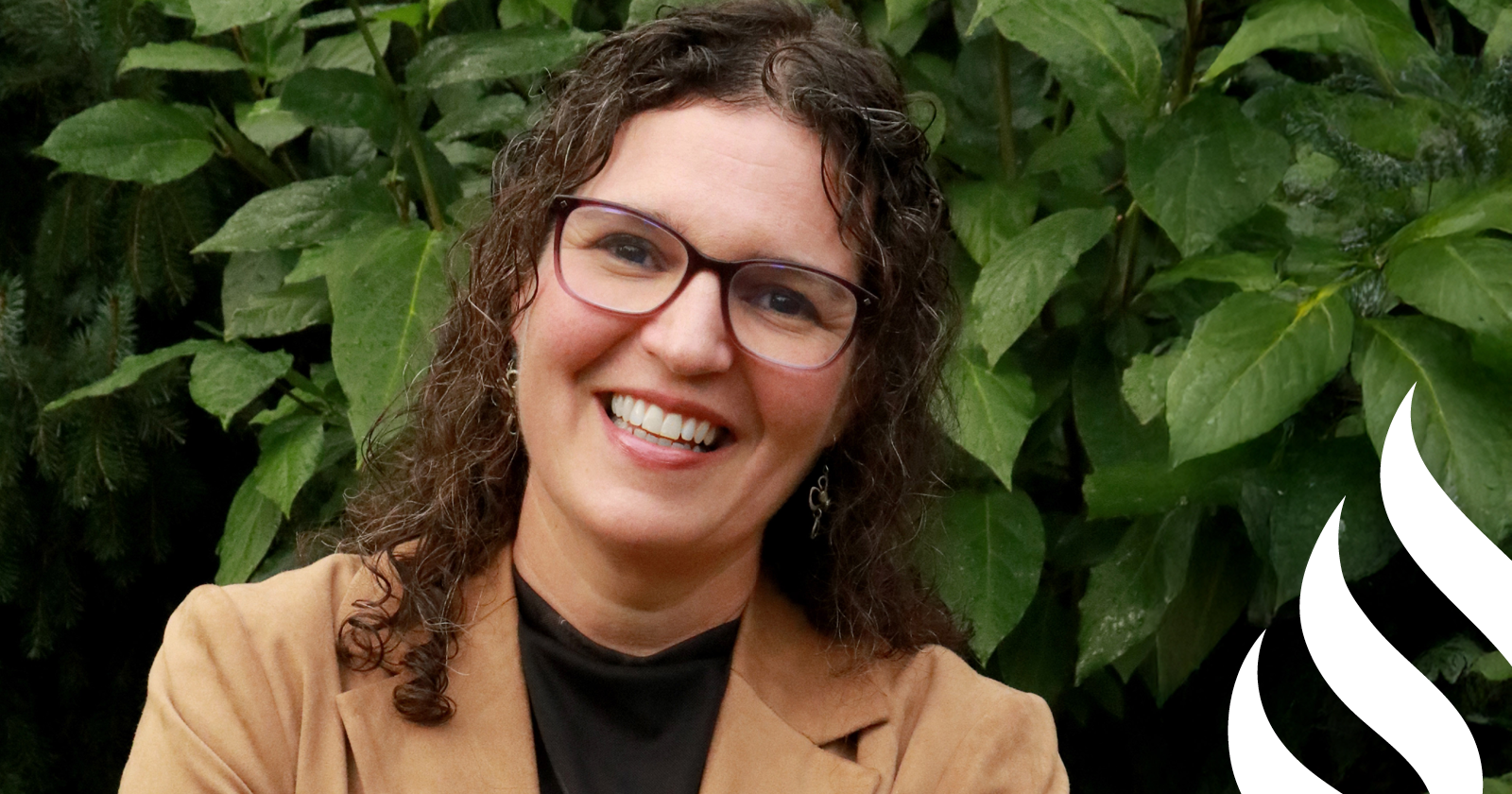
An educator, sociologist, rabbi, researcher, and former head of school, Tali spent the past seven years at The Wexner Foundation, where her work centered on leadership development and Jewish learning.
At Spertus, Tali’s role brings together academic leadership, teaching, faculty development, and the creation of new learning opportunities designed around the challenges Jewish professionals are navigating today.
Get to Know Tali
We sat down with Rabbi Dr. Zelkowicz to talk about the path that brought her to Spertus, what Jewish leadership requires in this moment, and what she hopes to build in her new role. This is an excerpt from that conversation.
You’ve been an educator, researcher, rabbi, and head of school. How have those different roles prepared you for this one?
This role is an uncanny combination of my career thus far, an intellectual and professional safari marked by convening across difference.
I think of my different roles as a large Venn diagram with educator at the center, because education is ultimately about moving from what is to what can be.
My work as a sociologist and qualitative researcher allows me to observe culture, consider every artifact and interaction as potentially relevant data, and to detect and analyze patterns. As a rabbi, I bring a pastoral approach to holding tension in the sometimes messy but very human work of individual and communal growth. And serving as a head of school taught me to work on nearly every professional front at once, from educational leadership and strategy, to governance, fundraising, communication, and so much more.
All of these experiences come together in this role at Spertus.
What drew you to Spertus, and what have you discovered since arriving?
When I interviewed, I had this evolving feeling in my kishkes that there was something unusual here. I couldn’t fully articulate it then. Now I can.
Spertus inhabits one of the most unique spaces I’ve experienced on the Jewish professional landscape. It combines immersive in-person learning experiences with sophisticated online learning. It is Jewish and non-denominational, and serves people across the denominational but also across the communal spectrum. And it offers both excellence and accessibility, providing rigorous learning while making it financially possible for people working in the nonprofit sector.
Our upcoming Executive Master’s in Jewish Professional Studies (EMAJPS) is a great example. Designed for experienced leaders, the 18-month program combines onsite and online learning, an immersive cohort experience, and one-on-one executive coaching. Substantial grant support allows us to offer students scholarships that bring tuition to less than half of what it costs Spertus to provide the program.
Part of what I hope to do is proudly proclaim Spertus’ mission and its still-too-often-unsung treasures from the rooftops of Chicago and beyond, creating the resounding equivalent of shevarim—the three shofar blasts—to communicate our triple commitment to intellectual rigor, social responsibility, and convening across difference.
You often return to the idea, “Never let your schooling interfere with your education.” What does that mean to you, and for Spertus?
If by education we mean enabling learners to develop relevant knowledge, skills, and habits of mind, and to integrate them in ways that give people the capacity to act and create positive change, then, unfortunately, far too often, what we call “schooling” fails to deliver.
But abandoning schooling will not make us more educated.
What will, though, is a creative and courageous realignment of schooling around what education should accomplish: not only to possess knowledge, but to develop deep understanding, along with the desire and agency to use it to author a better present and future.
That commitment is at the heart of what Spertus is building. A big part of what drew me to this amazing team and mission is that as a school, Spertus pledges daily never to interfere with its education.
You talked about the surprising role of destruction in creation. What does Jewish leadership need to be willing to let go of in order to build what comes next?
I am someone who leans into conflict. I think of it like plants leaning toward light in order to grow. Tension is often where complex and messy but valuable truths live.
One of the central ideas of adaptive leadership is that the work of leaders is about helping people manage loss in order to manage change. The two-part question becomes: What is the DNA that defines and improves us that we need to hold onto, and what is no longer serving us that we need to let go of?
That doesn’t mean disruption for disruption’s sake. You don’t throw a brick through the glass and say, “We’re going to shatter everything and start over.” That’s not leadership. That’s a tantrum.
One thing we need to loosen our grip on is the silos in Jewish communal life, whether denominational, ideological, or organizational. What could it look like to turn down the anxiety and have fewer red lines while holding on to meaningful differences, and recognize the needs and values we share across those boundaries?
What does that mean for Jewish education?
I think we also need to let go of the idea that the job of Jewish educators is to “make Jews.”
Instead, education should empower people to navigate their identities with increasingly robust skills and tools, to become ever-better authors, engineers, and designers of their own identity work.
For me, that means integrating what I call Transmission and Translation. While Transmission preserves the timeless knowledge and content that has sustained us across generations, Translation makes that content relevant and usable for a particular learner in a particular time and place.
What I would like to help us let go of is the either/or thinking that says we must choose one or the other. Leadership and education require us to maintain the productive tension between equally important leadership principles that are simultaneously contradictory and interdependent.
You’re still new to the role. What are you most excited to build at Spertus?
I’m diving into our courses and syllabi, looking across the curriculum for places to sharpen, expand, reinforce, and innovate.
I’m also excited about continuing to build a strong sense of identity and belonging among our incredible Spertus faculty. Academics can be very lonely professionally. Spertus offers something rare and nourishing: intellectual rigor alongside genuine community, collegiality, and collaboration.
There is already something very special here. My job isn’t to arrive and overhaul it. It is to listen, understand what makes it work, and help imagine what more it can become.